Learning Objectives and Modules
Learn the intricate design and techniques of Madhubani paintings along with live artist interaction. Also, learn the importance and relevance of the Madhubani painting, the folk stories behind the paintings, and their relevance in modern times.
What we will learn :
Module Details
Module 1: Drawing and detailing the outer borders
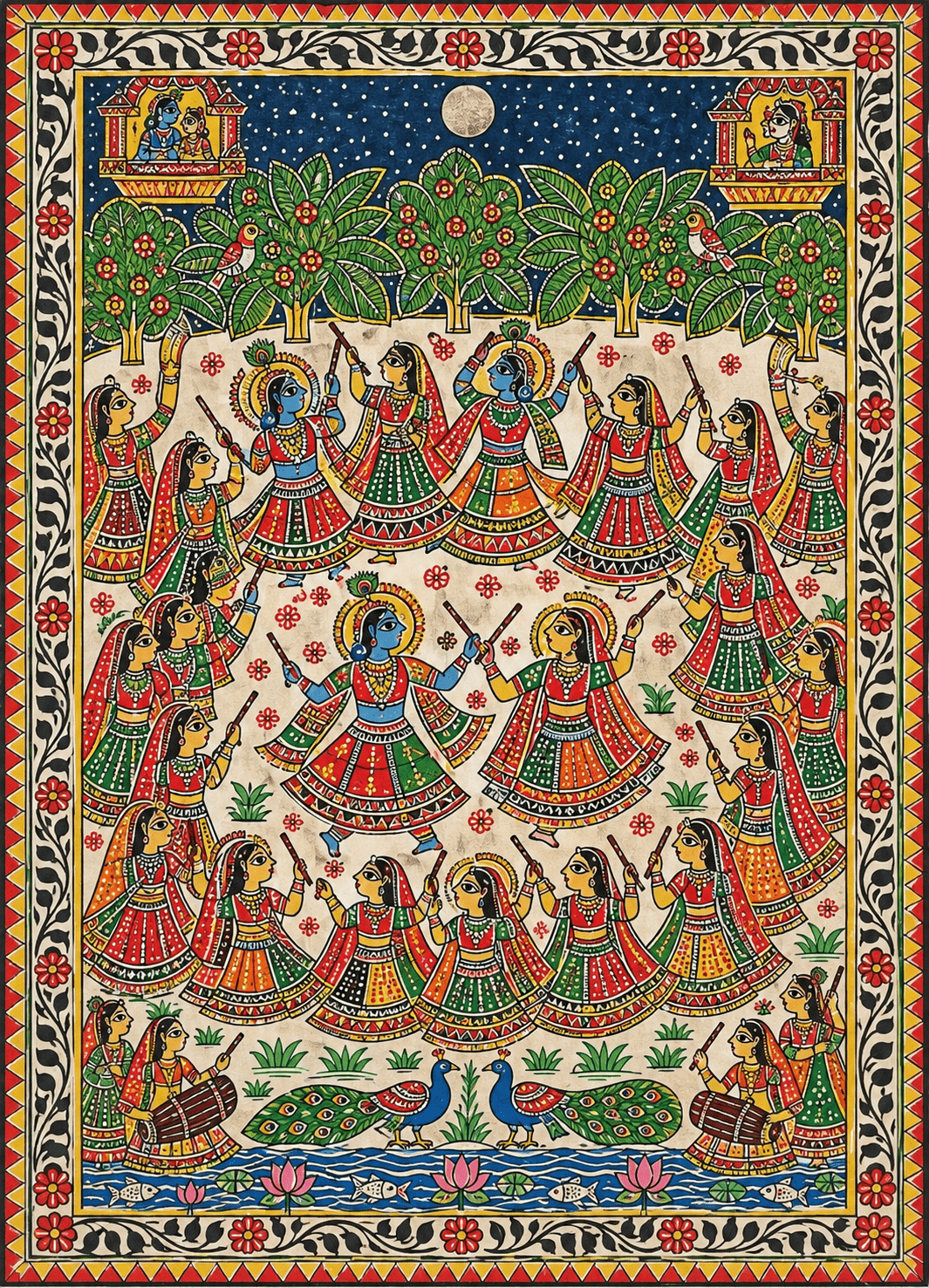
Create the painting's outer borders and customize traditional Madhubani patterns with floral, leaf, and geometric motifs.
Module 2: Drawing the top decorative panels
Draw and detail the two small decorative panels at the upper corners, including the figures, architectural elements, and ornamental patterns.
Module 3: Creating the night-sky background
Fill the upper background with the night-sky composition and add the moon, clouds, and small decorative dots to create a celestial effect.
Module 4: Drawing and detailing the trees
Draw the large trees across the upper section, adding branches, leaves, flowers, and fine traditional Madhubani detailing.
Module 5: Drawing and detailing the birds
Add the birds sitting among the trees and complete their feathers, patterns, and decorative details.
Module 6: Drawing the central dancing figures
Create the main composition of Krishna and the surrounding dancing figures, focusing on their postures, proportions, and graceful movements.
Module 7: Detailing the faces, hair, and ornaments
Detail the facial features, hairstyles, crowns, jewellery, and other traditional elements of the central figures.
Module 8: Detailing the costumes and accessories
Complete the sarees, dupattas, garments, borders, patterns, and decorative accessories of the dancing figures.
Module 9: Drawing and detailing the surrounding figures
Continue with the figures placed around the central composition, including their poses, costumes, jewellery, and traditional Madhubani patterns.
Module 10: Drawing the musical instruments and musicians
Add the musicians and their instruments, carefully detailing the drums, sticks, postures, costumes, and ornaments.
Module 11: Creating the lower landscape
Draw the grasses, plants, decorative foliage, and other natural elements in the lower section of the painting.
Module 12: Drawing and detailing the peacocks and water section
Create the two peacocks and develop their intricate feather patterns, followed by the flowing water, fish, lotus flowers, and leaves.
Module 13: Filling vibrant colours in the central composition
Fill the central figures with vibrant traditional colours, maintaining clear separation between the costumes, ornaments, and decorative patterns.
Module 14: Filling colours in the background and borders
Complete the colours of the trees, birds, flowers, water, peacocks, upper panels, and outer borders while maintaining the characteristic Madhubani style.
Module 15: Final detailing and finishing touches
Add final fine lines, patterns, highlights, and decorative details throughout the painting to complete the artwork with a balanced, traditional Madhubani finish.